An Insight to 'As You Like It'
'As You Like It' is a magnificent piece that revolves around the story of two cousins - Rosalind and Celia, who have grown up together under the rulings of Duke Senior and then Duke Frederick when he overthrows his brother, Senior, to become the new duke. The story starts with Orlando, who defeats Duke Frederick's servant "Charles the Wrestler" - which is unheard of as he even says that "he that escapes me without some broken limb shall acquit him well." (Act 1 Scene 1) a proof of his confidence and strength - and then flees into the Forest of Arden after falling in love with Rosalind after she cheers him on in the fight. Because Rosalind supported Orlando, she is banished as the final straw, Celia goes along with her to support her beloved cousin and is accompanied by the court's clown Touchstone. Rosalind decides to disguise herself as a farmer's boy named Ganymede to stop suspicion. They come to the Forest of Arden and settle in, Rosalind's banished father Duke Senior and his loyal men reside here. Orlando has been leaving love poems and songs around the forest for Rosalind, and this is discovered by her and her cousin. This delights Rosalind and she uses her disguise - Ganymede - to "help" Orlando into wooing Rosalind. While this is happening, Touchstone, the fool, is trying to woo a shepherdess named Audrey and hopefully have her in marriage so he can sleep with her. Phoebe, another shepherdess, falls in love with Rosalind as Ganymede, but has a lover following her named Silvius. While this is going on Orlando's brother Oliver is attacked by a lioness on his way to get Celia and Rosalind back, but is saved by Orlando. He then tells the tale of it to Celia and Rosalind, and falls in love with Celia and she falls in love back. Eventually the play ends with Hymen marrying Celia to Oliver, Rosalind to Orlando, Audrey to Touchstone and Phoebe to Silvius.
Characters
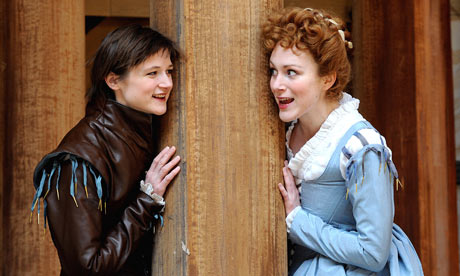 |
| Performing 'As You Like It' at the Globe Theatre |
'As You Like It' is a magnificent piece that revolves around the story of two cousins - Rosalind and Celia, who have grown up together under the rulings of Duke Senior and then Duke Frederick when he overthrows his brother, Senior, to become the new duke. The story starts with Orlando, who defeats Duke Frederick's servant "Charles the Wrestler" - which is unheard of as he even says that "he that escapes me without some broken limb shall acquit him well." (Act 1 Scene 1) a proof of his confidence and strength - and then flees into the Forest of Arden after falling in love with Rosalind after she cheers him on in the fight. Because Rosalind supported Orlando, she is banished as the final straw, Celia goes along with her to support her beloved cousin and is accompanied by the court's clown Touchstone. Rosalind decides to disguise herself as a farmer's boy named Ganymede to stop suspicion. They come to the Forest of Arden and settle in, Rosalind's banished father Duke Senior and his loyal men reside here. Orlando has been leaving love poems and songs around the forest for Rosalind, and this is discovered by her and her cousin. This delights Rosalind and she uses her disguise - Ganymede - to "help" Orlando into wooing Rosalind. While this is happening, Touchstone, the fool, is trying to woo a shepherdess named Audrey and hopefully have her in marriage so he can sleep with her. Phoebe, another shepherdess, falls in love with Rosalind as Ganymede, but has a lover following her named Silvius. While this is going on Orlando's brother Oliver is attacked by a lioness on his way to get Celia and Rosalind back, but is saved by Orlando. He then tells the tale of it to Celia and Rosalind, and falls in love with Celia and she falls in love back. Eventually the play ends with Hymen marrying Celia to Oliver, Rosalind to Orlando, Audrey to Touchstone and Phoebe to Silvius.
Characters
- Duke Senior, the banished Duke. Father to Rosalind, uncle to Celia and Brother of Duke Frederick. His servants, the Amiens and a titled follower of his Jaques, all live in the Forest of Arden as a means of survival and well being, to escape the court of his brother Duke Frederick.
- Duke Frederick, the current Duke who has overthrown Senior. Father to Celia, Uncle to Rosalind and brother of Senior. Currently at top of the court with his loyal servants such as Charles the Wrestler and Le Beau, a courtier.
- Oliver, brother of Orlando and Jaques de Boys and son of Sir Rowland de Boys. Current owner of a fortune that his father left for his sons.
- Orlando, brother of Oliver and Jaques de Boys and son of Sir Rowland de Boys. He wants part of the fortune that Oliver has, the one his father left for his sons, but Oliver disagrees and does not want to give it to him.
- Jaques (separate from Jaques de Boys), a melancholy courtier and loyal follower of Duke Senior and is mocked by the other lords for his seemingly depressing ways and philosophical manners.
- Touchstone, the clown of the court who accompanies Celia and Rosalind in their escape of the court, he takes Audrey - a shepherdess - as his wife so he can have his wicked way with her.
- Adam, servant of Oliver and servant and friend of Orlando. Also a servant to their father.
- Dennis, a servant of Oliver.
- Audrey, a country wench who eventually marries Touchstone, unaware of his wicked plans. She is uneducated and doesn't understand his witty talk.
- Corin, a farmer who sells a farm to Rosalind and Celia to live in. A friend of Silvius.
- Silvius, a shepherd living in the Forest of Arden. He is in love with a shepherdess named Phoebe. He eventually marries her.
- Rosalind, daughter of Duke Senior, niece of Duke Frederick and cousin and friend to Celia. She is banished from the court after rooting for Orlando in a fight. She takes on a male disguise called Ganymede. She falls in love with Orlando and he with she.
- Celia, the daughter of Duke Frederick, niece of Duke Senior and cousin and friend to Rosalind. She accompanies Rosalind after her banishment from the court, but doesn't have a disguise. She falls in love with Oliver and he with she.
- Phoebe, a shepherdess who falls in love with Rosalind as Ganymede. She eventually marries Silvius after Ganymede declines her love.
- Hymen, a goddess who comes down from the heavens and marries four couples at the end of the play to resolve all of the trouble in the Forest of Arden.
The Writing, Inspirations and Theatre of Shakespeare's Time
During Shakespeare's time, an actor was seen as a pretty big low in society. A little higher than prostitution in fact, not as high in today's society where actors are treasured and praised for their outstanding talents and dedication. In the Globe Theatre where Shakespeare eventually resided, (after his rocky road with his previous acting company), it was incredibly tough to keep the attention of all of the audience, Shakespeare had to write plays that would keep the audience into it, as the actors needed help to fight the overcrowded noise of the theatre. What Shakespeare would do to make sure that the audience was interested and to make up for the severe lack of set in most of his plays, he would introduce the scene using the character's description. In Act 2 Scene 1, Duke Senior comes in and states "Are not these woods more free from peril than the envious court?" to show the audience that we have now moved from the court to the woods. It keeps the audience up to where we are, and makes them more interested in the scene and broadens their imagination of the play. I personally love this as a way of exploring a scene's setting, it gives it more imagination and free will to how you want it to look, using nothing but the mind, costume and a small amount of props.
 |
| The Globe Theatre - Packed During a Play |
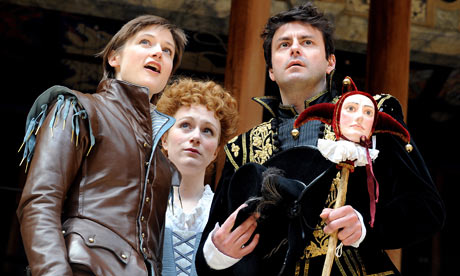 |
| Performing 'As You Like It' at the Globe Theatre |
Stage Design and General Staging of the Globe Theatre
The stage design for the Globe Theatre had a lot to do with the staging of 'As You Like It' by Shakespeare alongside the script writing and the blocking of the play, it was like nothing that anyone had ever seen. The Globe Theatre was built from the companionship of James Burbage (who was the manager of the acting company Earl of Leicester's Men) and his brother-in-law, John Brayne. Burbage originally had an idea that would bring more income and profit into the theatre business and for himself, he saw how play performances were incredibly popular, he came up with the idea of showing his plays to a larger audience. John Brayne also had the same idea, so as a result the two men rented a plot of land right outside London, where England's first theatre was created and opened in 1576. It was originally called The Theatre, however after a 25-year agreement, the landlord refused ownership to Brayne and Burbage because of apparent violence going on in the land, this resulted in the Burbages taking down The Theatre during Christmas in 1598, and then carrying the pieces to a different location in London. This is where a new theatre was built, they called it the Globe Theatre.

"The Globe Theater was a two-story stage tower design, with the stage in the centre of it all. The Globe Theater followed the typical layout of an Elizabethan Theater (see above). The stage was a raised platform, extending out into the pit, where the commoners could stand and watch the play. The tiring house was the backstage area in the Globe Theater. It held ladders, trapdoors and pulleys to create the special effects for the plays. Ladders and trapdoors were used so a player could appear or disappear as needed during a performance. For example, in performances of Hamlet, the Ghost enters the stage through a trapdoor. Pulleys and ropes were used to lower players down onto the stage."http://stagehistory.webs.com/renaissance.htm
'As You Like It' continues to wow audiences today with its parody and its extravagant stories of women in Shakespeare's time. Being such a dramatic expression in his time, it has survived throughout the ages and is being performed in present day. It still relates to audiences with the use of feminism and philosophy, and hopefully will carry on further.

Further to our conversation today Ellie, to improve your grade you need to go into greater detail; when you discuss the original staging make sure you go through the design of The Globe Stage, include a diagram for reference, then make direct links to how As You Like It would have been performed and how the elements of the staging would have been used in the original production, be specific. You could discuss the experience of theatre for both the Elizabethan actor and audience. You could also analyse the themes of the play more thoroughly, refer to the assignment brief and your notes and make sure you are explaining what relevance the themes/characters had for the audience then and how they are relevant now for a contemporary audience. Use quotes, images and video clips to illustrate and support statements you make.
ReplyDelete